

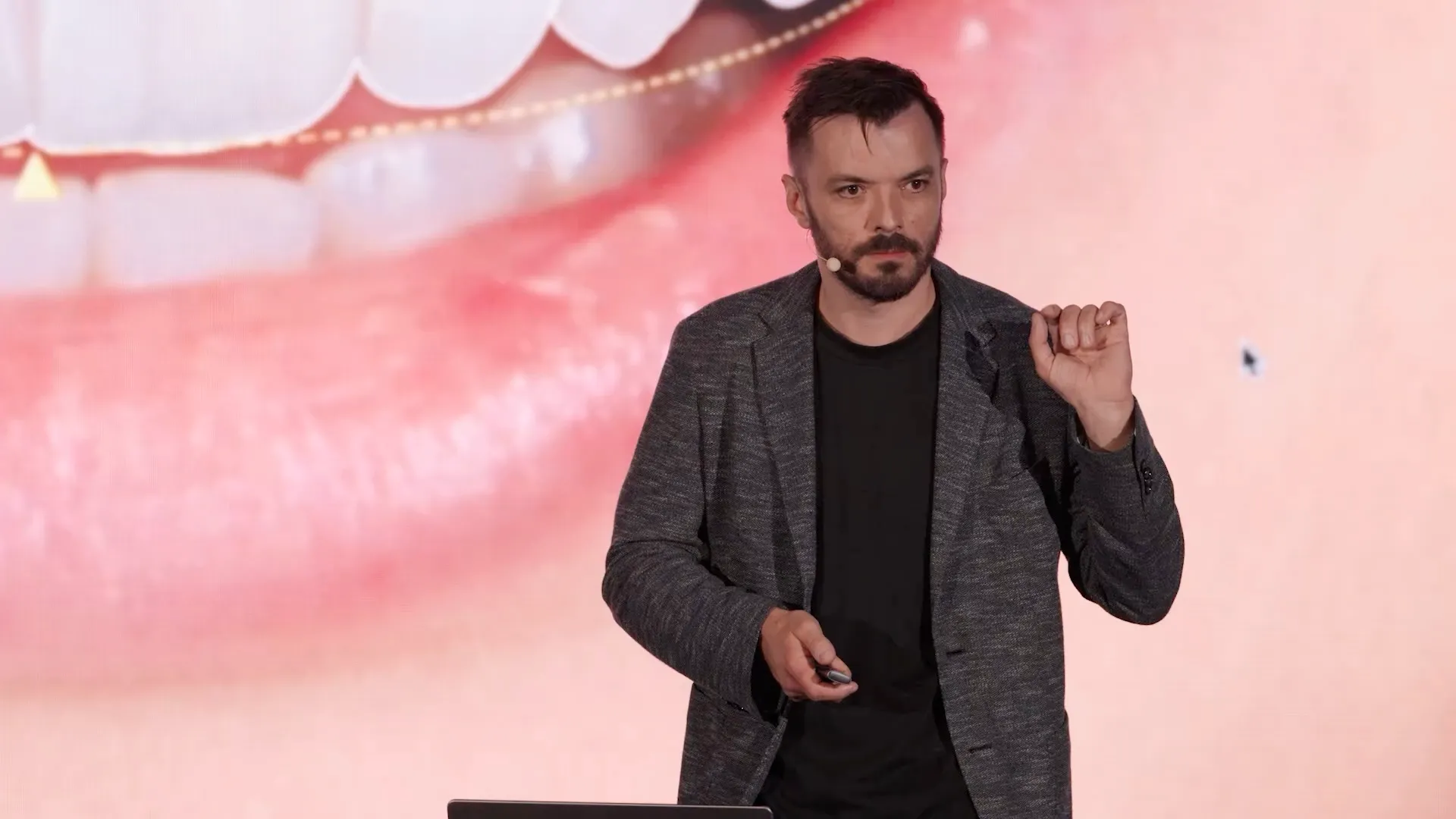
Smilecloud 3DNA
The closed launch of 3DNA, eight years in the making. Lectures from an international group of speakers, each mixing clinical work with their own story.
€360 every 6 months · Log in
Finale · 2024 · 1 parts
Finale
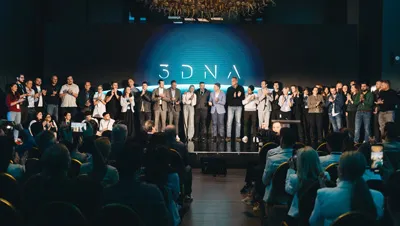
Florin's closing speech, with the whole team on stage.
- Speakers called back on stage
- Organisers and the Smilecloud team
- People behind the clinical work
01 Finale6 min
Florin closes the event and calls everyone on stage: the speakers, the organisers, the Smilecloud team and the people behind the clinical work.
3 chapters
- Speakers on stage
- The team behind the launch
- The clinical teams and thanks
Venceslav Stankov · 2024 · 3 parts
FP1: the papillae challenge
Preserving papillae in implant dentistry, and the virtual extraction model for full-arch planning.
- Virtual extraction model in 3DNA
- Four moments papillae get killed
- Negative model, before papillae drop
01 FP1 - the papillae challenge17 min
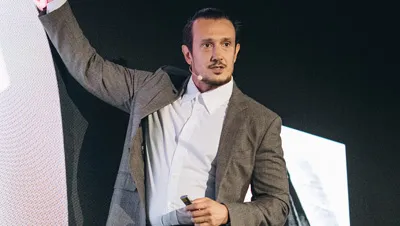
Venci tackles one of the hardest topics in implant dentistry: papillae in FP1. He starts by mapping what we know, what we think we know and what we don't, and the idea of prosthetically guided tissue.
7 chapters
- The FP1 tissue concept
- What we know about papillae
- Papilla height and position
- Forms that fit the tissue
- Killing papillae with the design
- Losing them at the impression
- Long papillae between pontics
02 VeX - virtual extraction model24 min
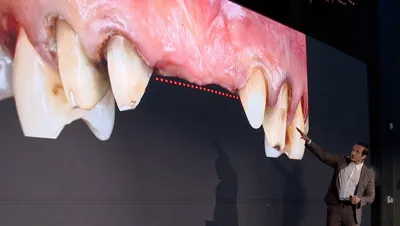
A patient Venci treated for 15 years now loses her teeth. How 3DNA and the virtual extraction model help plan forms, components and guides in full arch, so the papillae keep their support.
11 chapters
- Losing support at extraction
- Copying the root form
- Using shrinkage in class II
- From the worst papilla
- The virtual extraction model
- Ovate pontic forms
- Components before implants
- Connectors and milling
- Avoiding flaps at the front
- Guide and components clear
- Space for components
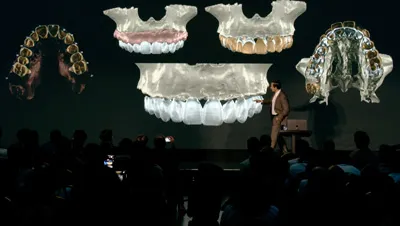
03 The hidden details that change the game18 min
Venci shows the four moments papillae get killed, in design, milling and the impression, and the negative model that captures them before they move.
9 chapters
- Guiding space, not components
- Milling versus printing
- The negative model
- Result and guided shrinkage
- Space for the papilla
- A second case with ortho
- Components fix the position
- Copying papillae to the final
- Prosthetics guide healing
Victor Clavijo · 2024 · 5 parts
One plan, different techniques
Decision trees that mix analogue and digital, for restorations and implants.
- No-prep full mouth at 35
- Mock-up off by 0.3 to 0.4 mm
- Failing implants, one kept, one removed
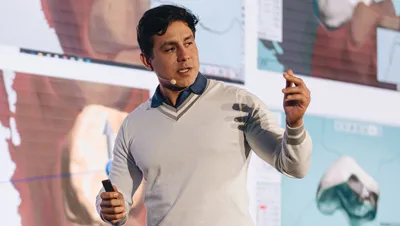
01 Many options17 min
Victor starts with his journey and the overwhelming decision tree of the modern dentist. How to choose when there are so many options, starting with sending the technician the right picture.
5 chapters
- Ten years of working together
- Choose the final material first
- More than veneers
- Records and design for the lab
- The right picture
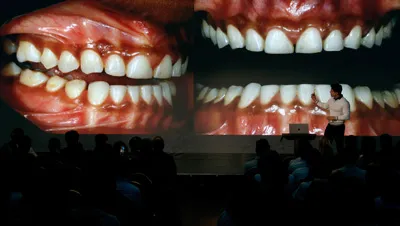
02 One plan. Different techniques28 min
Victor and his brother plan from the papilla: long or short, triangular or square, how much to prep. A pragmatic look at each technique, down to how flowable composite wears after three years.
12 chapters
- Papilla sets shape and prep
- Measure before preparing
- Dominance and black triangles
- Thickness and colour
- Validating the mock-up
- No-prep plan and build-ups
- Milled composite posteriors
- Lower anteriors by injection
- Injection technique details
- Palatal veneers and flowable
- Fracture, repair and veneers
- Wear after three years
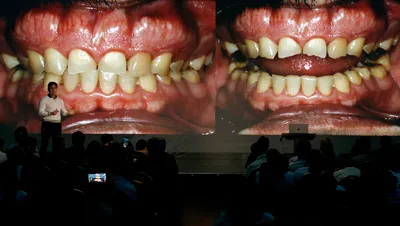
03 Analogue touches to the digital world21 min
Milled or layered, prep or no prep. On a no-prep full mouth case for a 35-year-old, Victor picks tools from both the analogue and the digital world, depending on what the case needs.
9 chapters
- Milled or direct composite
- Design and a no-prep choice
- Bonding with thick cement
- One-piece composite crowns
- A functional, natural result
- Small changes, measured
- Preparing in three steps
- Line angles matter
- Space for the technician
04 Implant fundamentals20 min
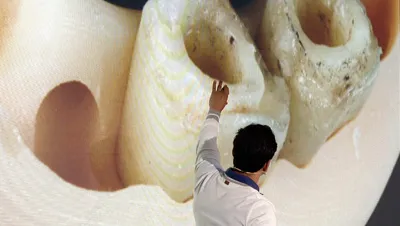
Victor moves to implants, starting from the future gingival margin: cut or push, how the provisional supports the papilla, and how to capture it in the right position.
9 chapters
- What lies under old work
- The future gingival margin
- Support the papilla, do not press
- Press rather than cut
- Masking a metal post
- Relining to support papillae
- Prep angle on dark substrates
- Deeper preps, scanned provisionals
- Materials and where to bond
05 Complexity13 min
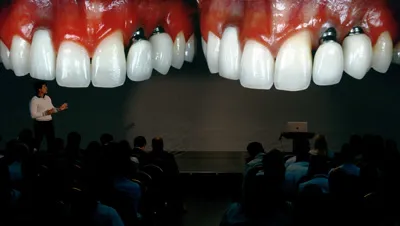
A patient back in 2018 with failing implants placed elsewhere. Victor finds the future gingival margin first, then decides: the 12 implant stays, the 22 is removed for a pontic.
6 chapters
- Failing implants from elsewhere
- Margin first, then decide
- Keeping the lateral implant
- Removing 22 for a pontic
- Outcome and colour
- Validate, then choose
Gustavo Giordani · 2024 · 4 parts
The band of brothers
A decision tree for anterior implant sites, soft tissue reconstruction, and how it all comes together.
- Mini plates, no orthognathic surgery
- Failing teeth kept to move tissue
- First millimetre of root, copied in PMMA

01 The band of brothers27 min
Gustavo starts his story: how he met Eric and Florin, and 10 years of coming from Brazil to Timisoara with his brother. Then the case begins, with mini plates for skeletal anchorage.
10 chapters
- Gustavo's path
- Ten years in Timisoara
- A central and lateral to replace
- Is it an immediate implant case
- Start from the patient
- Redesigning the smile
- The design calls for ortho
- Keeping the teeth to move tissue
- Placing mini plates
- The design as STL
02 Framework19 min
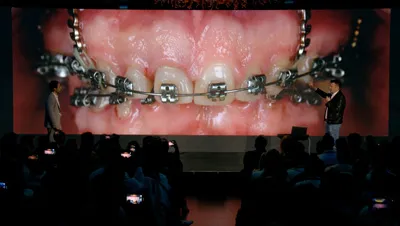
Johnny Barbur joins Gustavo for the orthodontic side: intrusion with mini plates instead of orthognathic surgery, brackets placed on a setup driven by the design, implants as anchorage. Then the plan to extract the anteriors one at a time.
10 chapters
- Ortho instead of orthognathic surgery
- A setup driven by the design
- Intrusion with mini plates
- Implants as anchorage
- Healing abutments and gingivectomy
- One anterior at a time
- Redesign and preps first
- Placing the lateral implant
- Copying the root
- Filling the gap
03 Soft tissue reconstruction17 min
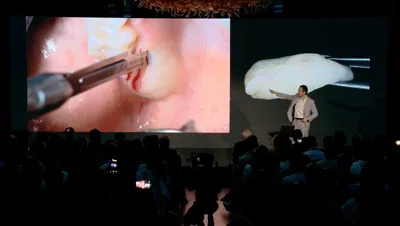
Soft tissue reconstruction in detail: harvest sites, the linear technique, the tuberosity, de-epithelialised grafts, and which graft fits which indication. Then back to the case, starting with the lateral incisor.
6 chapters
- Why more tissue
- Palatal anatomy
- The linear technique
- Tuberosity for reconstruction
- De-epithelialised grafts
- Grafting the lateral site
04 How it all comes together14 min
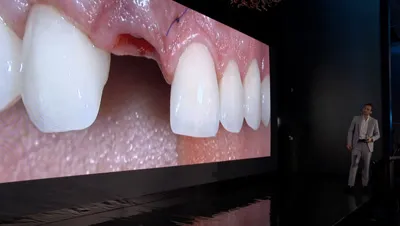
The same protocol for the central, copying the first millimetre of the root into the provisional, which stays in PMMA to shape the tissue until the final zirconia crown. Ortho, implants and prosthetics follow one design.
6 chapters
- Planning the central
- Copying the root
- Graft and biomaterial
- Ceramics and provisional
- Final crown and reshaping
- How it came together
David Norre · 2024 · 4 parts
STAR Concept: the Belgian blend
From the early days of guided surgery to managing failure, with a case told step by step.
- Teeth hold the guide in 80% of 354
- Temporary redesigned in 3DNA, 4 min
- Lower bridges segmented for flexure
01 STAR Concept: The Belgian Blend20 min
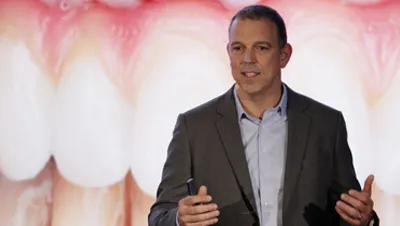
David starts with his early days as a self-declared papilla killer and a simple question: what is a beautiful smile? Then the unexpected, a guided case that went wrong and how he finished it freehand.
7 chapters
- From papilla killer to creator
- Start from the face
- Why bone reduction
- Building the digital patient
- Why not every case is guided
- Early guided surgery in Leuven
- A guided case that went wrong
02 The Original Gangster23 min
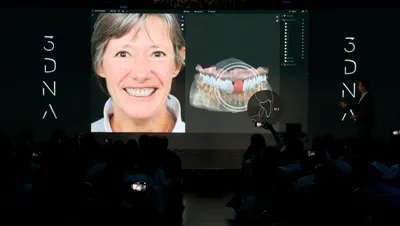
David breaks down the STAR concept: negative grafting, the four types of full arch patients, and how in 80% of his 354 cases the remaining teeth are enough to hold the guide.
11 chapters
- What went wrong
- Challenges and negative grafting
- Four types of full-arch patients
- Collecting and assessing the case
- Four rules for FP1
- Designing in 3DNA
- The functional mock-up
- Segmentation and top-down planning
- Spacing by the abutments
- Open guide, pins drilled last
- Sleeves and drilling protocol
03 Fundamentals - a clinical narrative24 min
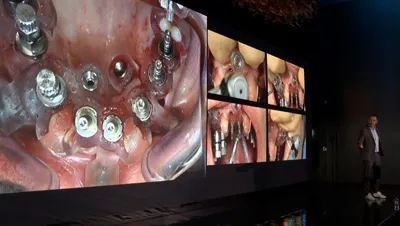
David's case presentation, step by step: the open guide, implants placed one by one starting next to a tooth, pins drilled only at the end, the pickup of the temporary bridge, and the try-in.
11 chapters
- Driver and open guide
- Implants one by one
- Picking up the temporary
- The prosthesis is the boss
- Heat map and a fractured crest
- One scan and segmented try-in
- Segmented and monolithic
- Flat designs for papillae
- Limits of the approach
- Bone reduction with three guides
- Healing, impression and try-in
04 Tips and tricks17 min
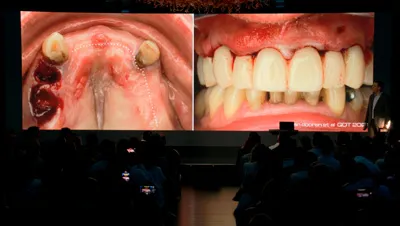
David redesigns a temporary in 3DNA in four minutes, then goes through pontic design for FP1 and FP3, the roll flap, segmenting lower bridges for mandibular flexure, and his 4-3-2 recall.
9 chapters
- Redesigning a temporary in 3DNA
- Pontics in FP1 and FP3
- The roll flap
- Materials and fees in FP3
- Pressing the tissue at insertion
- Creating buccal tissue
- Pontic shapes to avoid
- Mandibular flexure and segmentation
- Maintenance recall
Wael Att · 2024 · 4 parts
STAR Concept: the Boston narrative
The full-arch landscape, immediacy in evidence, and the STAR Concept step by step.
- Bone reduction only for knife-edge ridge
- Teeth designed further in and up
- Final zirconia in segments
01 STAR Concept: The Boston Narrative21 min
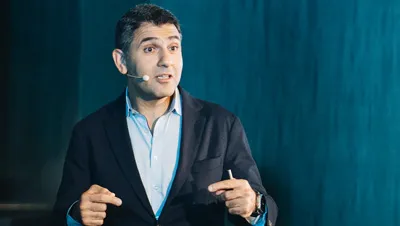
Wael starts with context: how full arch treatment changed since the first Smilecloud meeting in 2019, the trends and challenges, and the FP1, FP2, FP3 classification, with FP1 the hardest to get right.
10 chapters
- Introducing Wael Att
- From Freiburg to Boston
- Acquire, process, execute
- An older full-arch case
- Setting the prognosis
- Treatment options for the full arch
- Guided implants, freehand temporary
- Prototype before the final
- Zirconia with facial veneering
- FP1, FP2 and FP3
02 Immediacy: the current status22 min
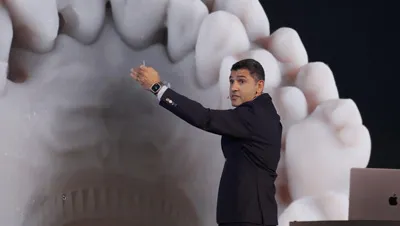
Wael compares the old protocols that left the patient edentulous first with stackable guides. Bone reduction is indicated only for a knife-edge ridge or to hide an FP2 transition.
11 chapters
- Immediacy ten years ago
- Stackable guides
- Instagram education
- Cutting the bone en bloc
- Do not reduce the bone
- The STAR concept
- Data and a motivational try-in
- Set three acceptable retentions
- Singular design and components
- Surgery with a tooth-supported guide
- Teeth kept as stoppers
03 STAR Concept26 min
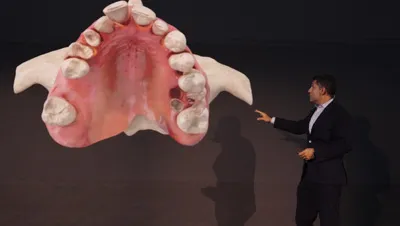
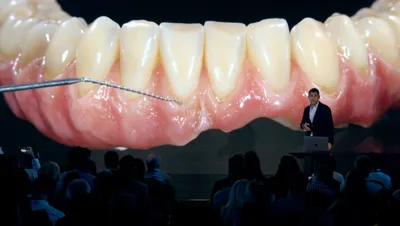
The STAR concept step by step, on a live surgery case from Boston. Wael plans for the three-dimensional shrinkage after extraction, deconstructs the case in the design and puts it back together in one surgical visit.
13 chapters
- Functional design in 3DNA
- Automated 2D smile design
- Motivational try-in
- Planning for 3D shrinkage
- Skipping the motivational design
- Stacking the data
- Simulating the functional design
- From blueprint to guides
- Heat map for preps and bone
- The surgical sequence
- Live surgery in Boston
- Multi-units and the pickup
- Outcome and benefits
04 Clinical stories18 min
Temporary and final in full arch. Wael covers reverse scan bodies, verification jigs and jaw motion tracking, and segments the final zirconia instead of making it one piece.
9 chapters
- Scanning for the final work
- Verification jig
- Recording function
- Segmented zirconia
- Chipping and zirconia variants
- Zirconia claims and evidence
- Why segment the final work
- Recommendations for zirconia
- Summary and thanks
Thiago Ottoboni · 2024 · 2 parts
Composites in the digital era
Predictable composite restorations, from a different reality on a different continent.
- Printed guides for dentin and enamel
- Over 0.5 mm enamel turns grey
- Ten veneers in 2.5 hours
01 Composites: design first27 min
Thiago starts from the reality of composites in Brazil, where ten veneers in 30 minutes without planning is common. Why composites need a design first, and how he builds it in Smilecloud before touching the patient.
12 chapters
- Introducing Thiago Ottoboni
- Composites without planning
- Design first in the face
- Classic or guided layering
- The first visit
- Options for one patient
- Layer thickness in the blueprint
- Guides and printed models
- Enamel no thicker than 0.5 mm
- Colour and light refraction
- Classic layering on the case
- Tints and the buccal layer
02 Composites: guided layering28 min
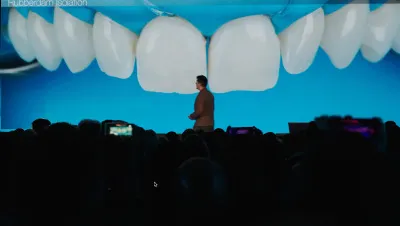
Ten composite veneers with guided layering of dentin and enamel, finished in about two and a half hours instead of five by hand. It ends on a personal video and a thank you from Thiago and his brother.
12 chapters
- Finished in one visit
- Ten veneers, guided
- Why guide enamel and dentin
- The guided layering workflow
- Designing in 3DNA
- Perio, dentin and enamel guides
- Crown lengthening and guide try-in
- Sandblasting and etching enamel
- Layering dentin through guides
- Palatal shell and enamel guides
- Finishing and bone surgery
- Take-home message
Eric van Dooren · 2024 · 4 parts
East and West, 30 years apart
Two careers that converge: a 30-year perio-prosthetic retrospective, and how 3DNA changes planning and execution.
- Patient from 2001, back after 17 years
- Apical guide, the only component
- Graft up to half the shortest papilla

01 A story of East and West, 30 years apart25 min
Eric van Dooren graduated in 1982, the year Florin was born. Two careers, 30 years and a world apart, that meet in a story about dentistry, mentorship and embracing change.
10 chapters
- Introducing Eric van Dooren
- Dentistry in 1982
- Learning without the internet
- The team years
- Standardised documentation
- Motivational versus final mock-up
- A case from 16 years ago
- Mock-up on top of tissue
- Crown lengthening by the zenith
- Biologic width as a bell curve

02 The fundamentals15 min
Eric looks back at three decades of his own perio-prosthetic cases with today's eyes: mock-ups, crown lengthening, 2 to 3 mm of attached tissue, and what he would do differently.
8 chapters
- Motivational or functional mock-up
- Reshaping and a second design
- Why the technician says but
- Provisional veneers
- Re-prepping to move tissue
- Checking forms at try-in
- Nine years later
- Grafting and the long-term result
03 How 3DNA is changing the way we work19 min
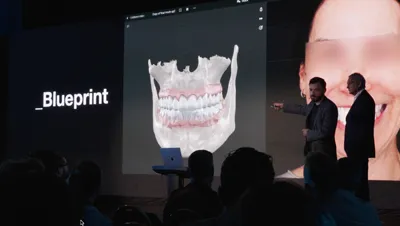
A patient Eric first treated in 2001, back after 17 years. Florin and Eric show how 3DNA changes the sequence: smile design becomes a blueprint in one click, and an apical guide as the only component the case needs.
9 chapters
- A patient back after 17 years
- Rethinking the sequence
- Nothing is eternal
- From smile design to blueprint
- Positioning teeth on the bone
- Planning gingival changes virtually
- Prosthetically guided healing
- Motivational design comes second
- Apical guide and simultaneous execution

04 Simultaneous execution and prosthetic guided healing24 min
Simultaneous execution in practice: flapless crown lengthening and chamfer placement with the apical guide, then prepping with an intermediate scan. Fewer appointments, less trauma, and the healing moved to the end, where it belongs.
11 chapters
- The apical guide
- Chamfer from the guide
- Prepping with intermediate scans
- Bonding and minimal CAD changes
- Resective first, then additive
- Root preparation and the flap
- Harvesting the connective graft
- Suturing and thinning the tissue
- Healing against porcelain
- Realistic graft limits
- Fewer appointments, better healing
Florin Cofar · 2024 · 2 parts
Memory lane and the next generation
Florin opens the launch with smile design since 2012, then unveils 3DNA.
- Biometrics behind the design
- Smile design, CAD, team in one model
- Everything exports as STL
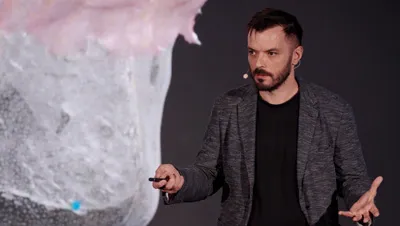
01 Memory lane22 min
Starting in 2012, when smile design meant transferring two lines from Keynote to a model. Florin goes through the moments that shaped digital dentistry, good and bad, and how biometrics bring scale and uniqueness to design.
9 chapters
- Opening the 3DNA launch
- 2012: smile design in slides
- Steps and the technician
- Paulo Kano and biometrics
- 2016: affordable 3D printing
- Biometrics are timeless
- 2019: Smilecloud launched
- What is new in smile design
- Planning CAD and the blueprint
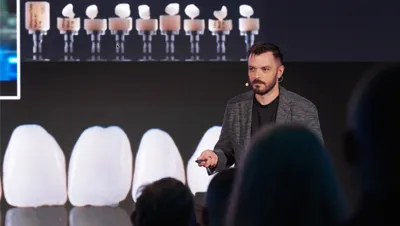
02 The next generation24 min
The unveiling of 3DNA. Smile design, CAD and collaboration in one model that scales with the data you have and exports everything as STL.
10 chapters
- One project, one model
- Scaling with the input
- An open STL layer
- Linear planning falls apart
- One plan, as in architecture
- The butterfly effect
- Visual language and presentation
- Working in the same project
- Sharing without a subscription
- Interdisciplinary smile design
Watch Smilecloud 3DNA and the whole library
One pass, €360 every 6 months: every Dentcof series and season, on any device. Cancel anytime.
Already a member? Log in